Confidence interval for the variance of a normal distribution
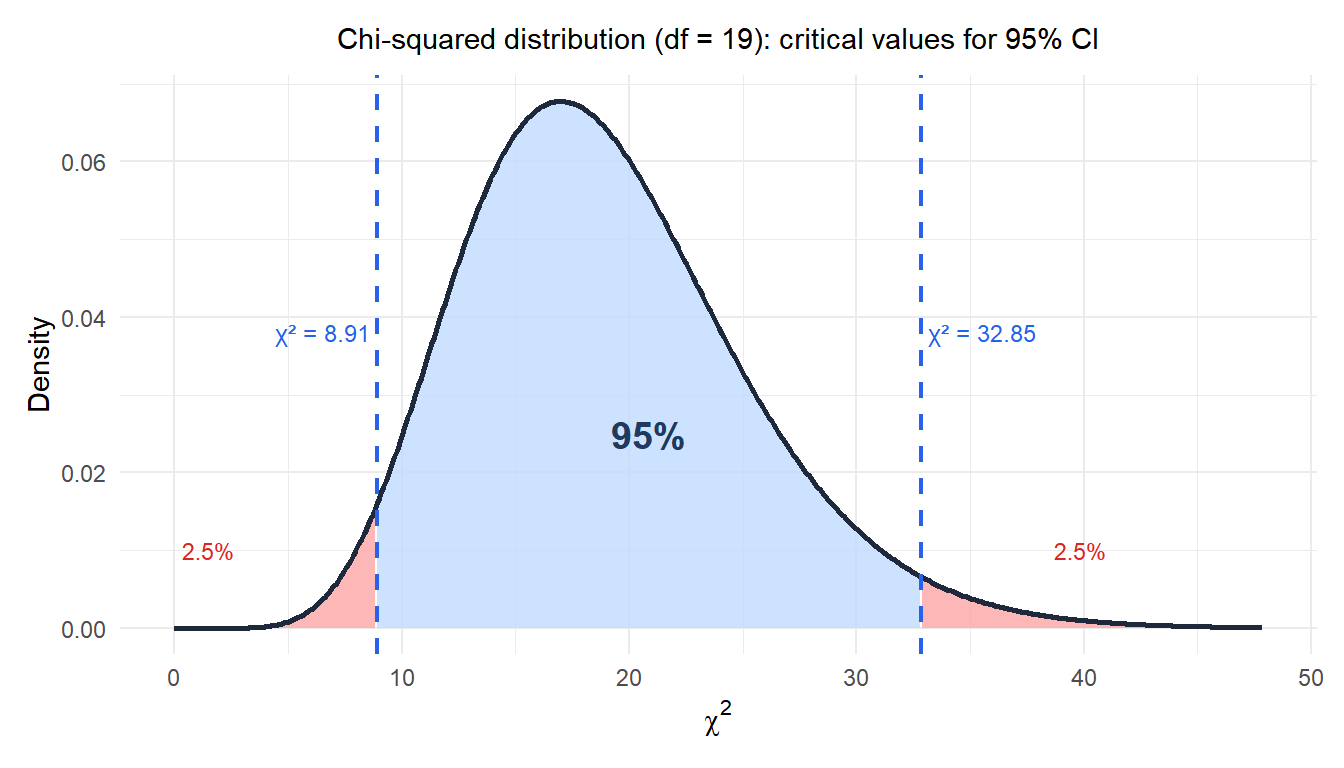
The confidence interval for a population variance uses the chi-squared distribution, not the normal or \(t\). Because the chi-squared distribution is right-skewed, the interval is asymmetric: the upper bound is always further from \(S^2\) than the lower bound.
Formula
If the population is normal and we observe a sample of size \(n\) with sample variance \(S^2\), then:
\[\frac{(n-1)S^2}{\sigma^2} \sim \chi^2(n-1)\]
Inverting this pivot gives a \((1-\alpha)\) confidence interval for \(\sigma^2\):
\[\left(\frac{(n-1)S^2}{\chi^2_{1-\alpha/2,\; n-1}},\;\; \frac{(n-1)S^2}{\chi^2_{\alpha/2,\; n-1}}\right)\]
Note the order of the critical values: the larger chi-squared value (\(\chi^2_{1-\alpha/2}\)) goes in the denominator of the lower bound, and the smaller (\(\chi^2_{\alpha/2}\)) goes in the denominator of the upper bound.
For a confidence interval for the standard deviation \(\sigma\), take the square root of both endpoints.
⚠️ The CI for variance is not symmetric around S²
The CI for a mean is symmetric: \(\bar{x} - \text{ME}\) to \(\bar{x} + \text{ME}\). The CI for variance is not: the upper bound extends further above \(S^2\) than the lower bound extends below it.
This asymmetry comes directly from the right skew of the chi-squared distribution. For small \(n\), the asymmetry is substantial. For example, with \(n = 10\) and \(S^2 = 25\):
- Lower bound: \((9 \times 25)/19.02 \approx 11.8\), which is \(13.2\) below \(S^2\).
- Upper bound: \((9 \times 25)/2.70 \approx 83.3\), which is \(58.3\) above \(S^2\).
The upper bound is more than four times further from \(S^2\) than the lower bound.
Chi-squared distribution and critical values
Step-by-step examples
Example 1: precision of a measurement instrument
A calibration lab tests a pressure gauge 20 times under identical conditions. The sample variance of the readings is \(S^2 = 4.2\) bar². Construct a 95% CI for the population variance.
Step 1: identify the ingredients.
\[n = 20, \quad S^2 = 4.2, \quad df = 19, \quad \alpha = 0.05\]
Step 2: find the critical values from the chi-squared table.
\[\chi^2_{0.975,\; 19} = 32.85, \qquad \chi^2_{0.025,\; 19} = 8.91\]
Step 3: compute the bounds.
\[\text{Lower} = \frac{19 \times 4.2}{32.85} = \frac{79.8}{32.85} \approx 2.43 \text{ bar}^2\]
\[\text{Upper} = \frac{19 \times 4.2}{8.91} = \frac{79.8}{8.91} \approx 8.96 \text{ bar}^2\]
\[\text{95\% CI for } \sigma^2: (2.43,\; 8.96) \text{ bar}^2\]
For the standard deviation: \((\sqrt{2.43},\; \sqrt{8.96}) = (1.56,\; 2.99)\) bar.
Example 2: packaging weight consistency
A food manufacturer samples 15 packages. The weights (in grams) give \(S^2 = 6.8\) g². Construct a 99% CI for \(\sigma^2\).
\[df = 14, \quad \chi^2_{0.995,\; 14} = 31.32, \quad \chi^2_{0.005,\; 14} = 4.07\]
\[\text{Lower} = \frac{14 \times 6.8}{31.32} \approx 3.04 \text{ g}^2, \qquad \text{Upper} = \frac{14 \times 6.8}{4.07} \approx 23.39 \text{ g}^2\]
\[\text{99\% CI for } \sigma^2: (3.04,\; 23.39) \text{ g}^2\]
The wide interval reflects both the small sample size (\(n=15\)) and the high confidence level (99%).
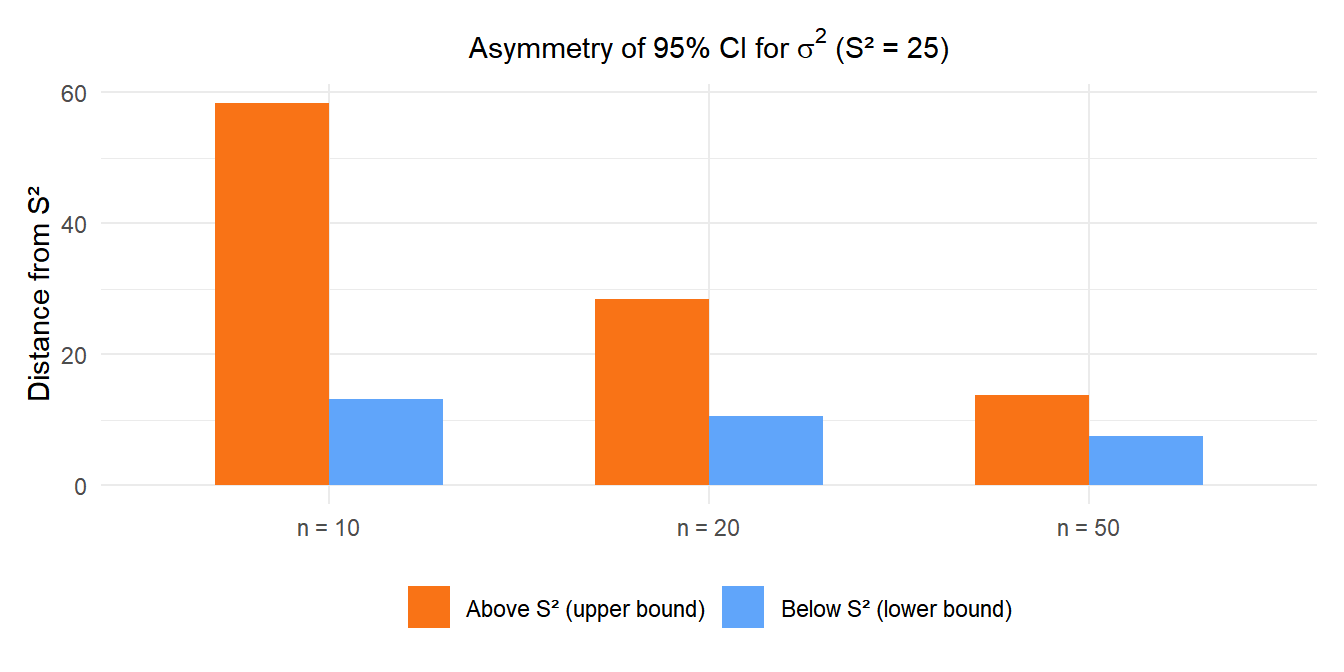
The upper bound (orange) is always further from \(S^2\) than the lower bound (blue), and the asymmetry is most pronounced for small samples.
⚠️ The normality assumption is critical here
Unlike the CI for a mean (which is robust to non-normality thanks to the CLT), the CI for variance derived from the chi-squared distribution is sensitive to departures from normality. For non-normal populations, this interval can be substantially incorrect even for large samples.
If normality is in doubt, consider:
- Testing normality before applying the formula.
- Using a bootstrap CI for variance, which does not assume normality.
- Reporting \(S^2\) with a bootstrap confidence interval when the data is clearly skewed.
💡 Connection with hypothesis testing
A \((1-\alpha)\) CI for \(\sigma^2\) is directly connected to the chi-squared test for variance. If the hypothesized value \(\sigma^2_0\) falls outside the CI, the test \(H_0: \sigma^2 = \sigma^2_0\) is rejected at level \(\alpha\). If it falls inside, \(H_0\) is not rejected.
This duality means the CI carries all the information of the hypothesis test, and also shows by how much the hypothesized value is plausible or implausible.