Variations
Variations count the number of ordered selections of \(r\) items from a set of \(n\), where order matters and items may or may not be reused. They are the general framework that connects permutations, combinations, and their repetition variants.
Definition and relationship to other concepts
A variation of \(r\) elements from a set of \(n\) is an ordered selection of \(r\) distinct positions filled from \(n\) available items. The key distinction from other counting methods:
| Method | Order matters | Repetition | Formula |
|---|---|---|---|
| Combinations | No | No | \(\binom{n}{r} = \frac{n!}{r!(n-r)!}\) |
| Variations without repetition | Yes | No | \(V(n,r) = \frac{n!}{(n-r)!}\) |
| Variations with repetition | Yes | Yes | \(VR(n,r) = n^r\) |
| Permutations | Yes | No | \(P(n) = n!\) (special case: \(r=n\)) |
Permutations are simply the special case of variations without repetition when all \(n\) items are selected (\(r = n\)).
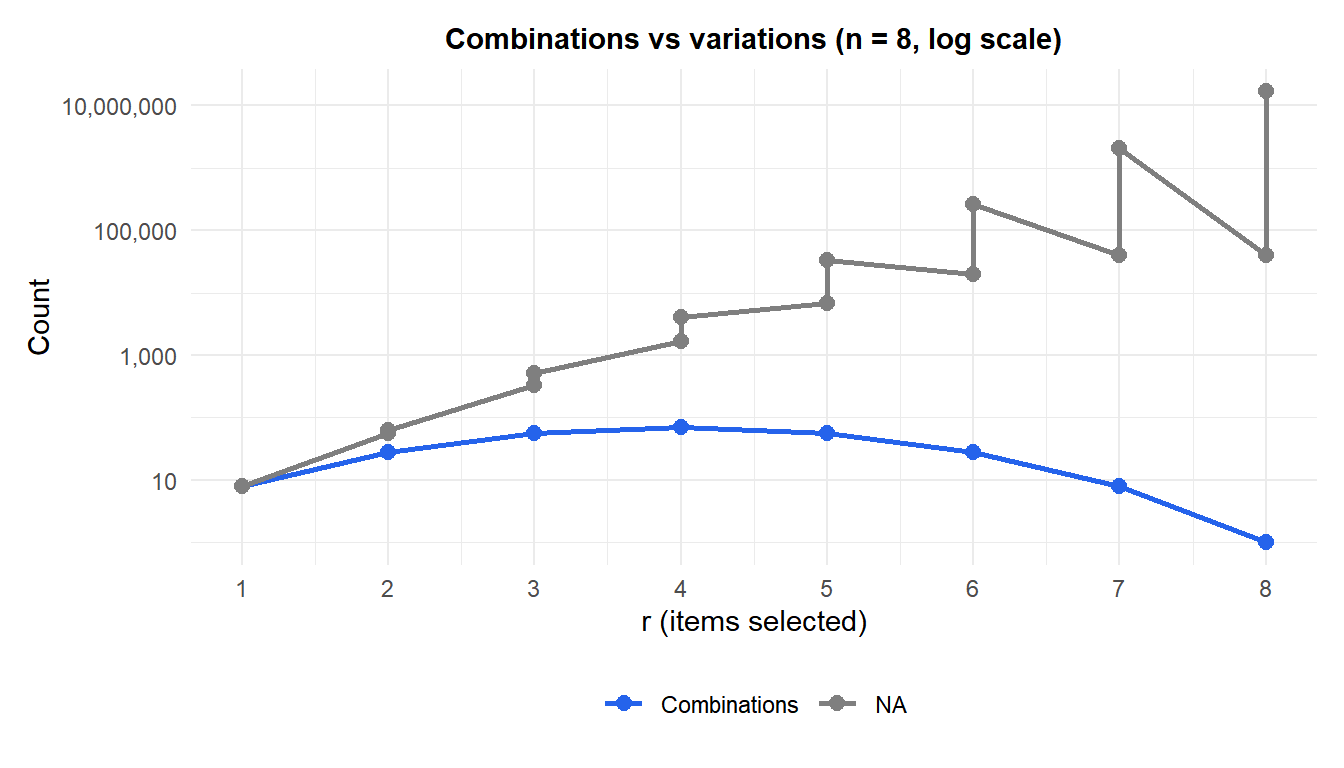
The chart makes the hierarchy clear: combinations give the smallest count (order ignored), variations without repetition are larger (order counts), and variations with repetition are largest (order counts and reuse allowed).
Variations without repetition
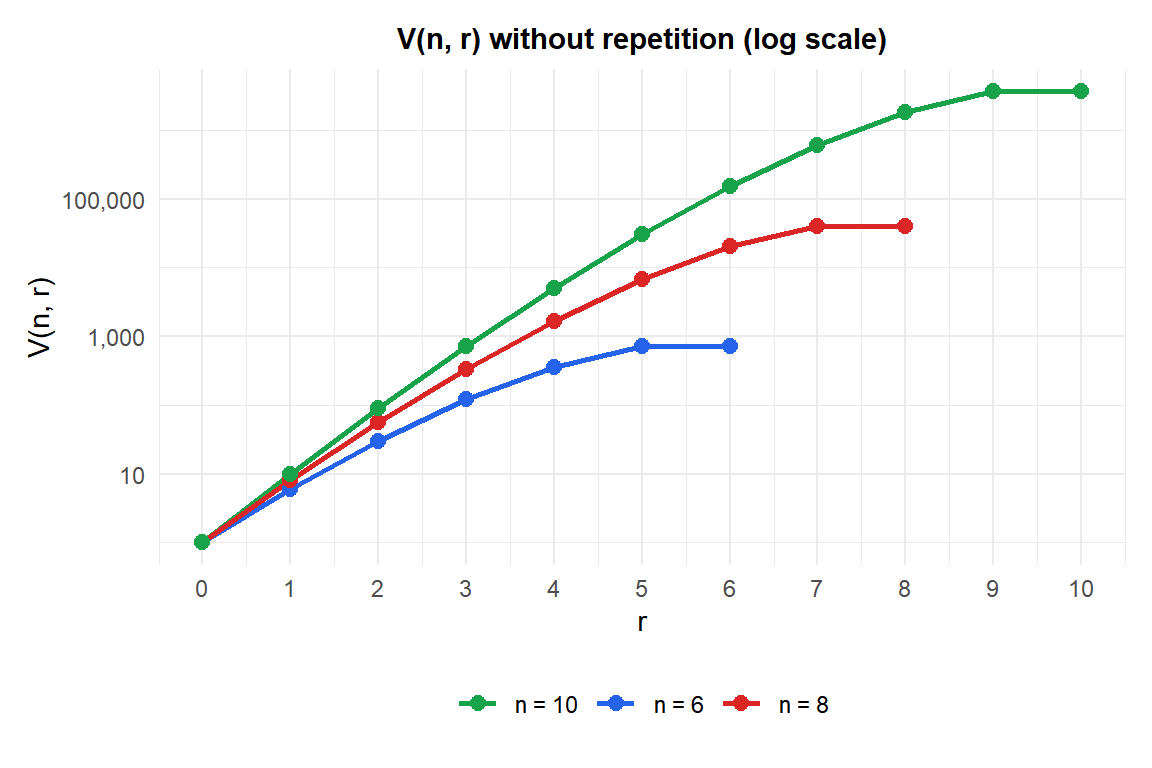
When each item can only be used once, the number of ordered selections of \(r\) from \(n\) is:
\[V(n, r) = \frac{n!}{(n-r)!} = n \times (n-1) \times \cdots \times (n-r+1)\]
This is identical to the permutation formula \(P(n,r)\). The difference is conceptual: “variations” emphasizes that we are selecting a subset and ordering it, while “permutations” is sometimes reserved for the full arrangement of all elements.
12 swimmers compete. How many distinct podium outcomes (gold, silver, bronze) are possible?
\[V(12, 3) = \frac{12!}{9!} = 12 \times 11 \times 10 = 1{,}320\]
The same 3 swimmers on the podium in a different order count as different outcomes: {Ana 1st, Beth 2nd, Cara 3rd} is different from {Beth 1st, Ana 2nd, Cara 3rd}.

A cluster has 10 servers and 4 tasks must be assigned to different servers, each task to a specific server (order of assignment matters for load balancing configuration).
\[V(10, 4) = 10 \times 9 \times 8 \times 7 = 5{,}040\]
If the tasks were interchangeable (any server handles any task equally), we would use \(\binom{10}{4} = 210\) instead.
Variations with repetition
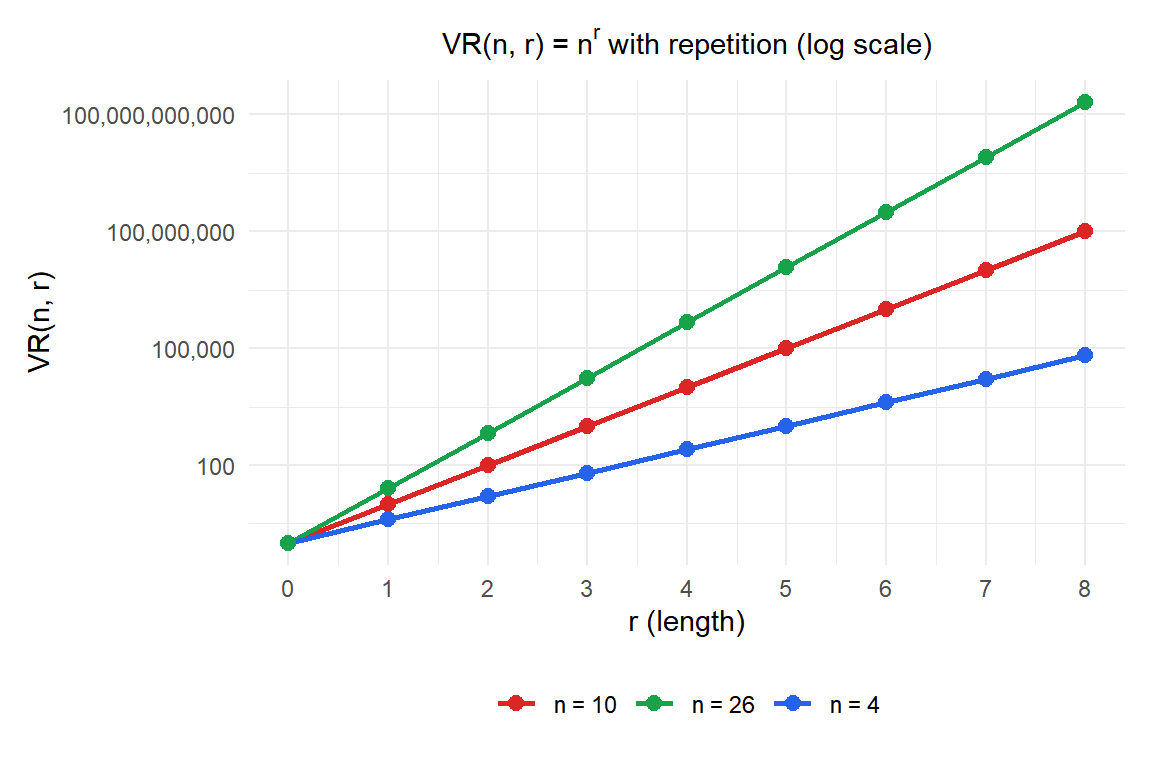
When items can be reused across positions, the count grows as a power:
\[VR(n, r) = n^r\]
Each of the \(r\) positions is filled independently from all \(n\) items, giving \(n\) choices per position.
A 4-digit PIN from digits 0-9, repetition allowed:
\[VR(10, 4) = 10^4 = 10{,}000\]
A 6-character code from 26 uppercase letters, repetition allowed:
\[VR(26, 6) = 26^6 = 308{,}915{,}776\]
Without repetition: \(V(26, 6) = 165{,}765{,}600\). The repetition constraint reduces the space by 46%.
DNA uses an alphabet of 4 bases (A, T, C, G). How many distinct sequences of length 10 are possible?
\[VR(4, 10) = 4^{10} = 1{,}048{,}576 \approx 10^6\]
For the human genome, sequences of length 3 billion are involved: \(4^{3 \times 10^9}\), an astronomically large number that explains the uniqueness of individual genomes.
How to choose the right formula
Three questions determine which formula applies:
- Does order matter? If no: combinations. If yes: continue.
- Can items be reused? If no: \(V(n,r) = n!/(n-r)!\). If yes: \(VR(n,r) = n^r\).
- Are all items selected? If yes and no repetition: \(P(n) = n!\) (permutations).
A company has 10 employees and needs to:
- Form a 4-person project team (no roles, no reuse): \(\binom{10}{4} = 210\) combinations.
- Assign 4 distinct roles (CEO, CTO, CFO, COO) from the 10 (roles differ, no reuse): \(V(10,4) = 5{,}040\) variations without repetition.
- Generate a 4-digit access code from 10 digits (repetition allowed, order matters): \(VR(10,4) = 10{,}000\) variations with repetition.
- Schedule all 10 employees in a presentation order: \(P(10) = 10! = 3{,}628{,}800\) permutations.
💡 Variations as the unifying framework
Variations provide the most general counting framework for ordered selections:
- Combinations = variations without repetition ÷ \(r!\) (divide out the orderings).
- Permutations = variations without repetition with \(r = n\).
- Variations with repetition = the most general case.
When in doubt, start by asking whether order matters and whether repetition is allowed. Those two answers point directly to the right formula.