Intersection of events
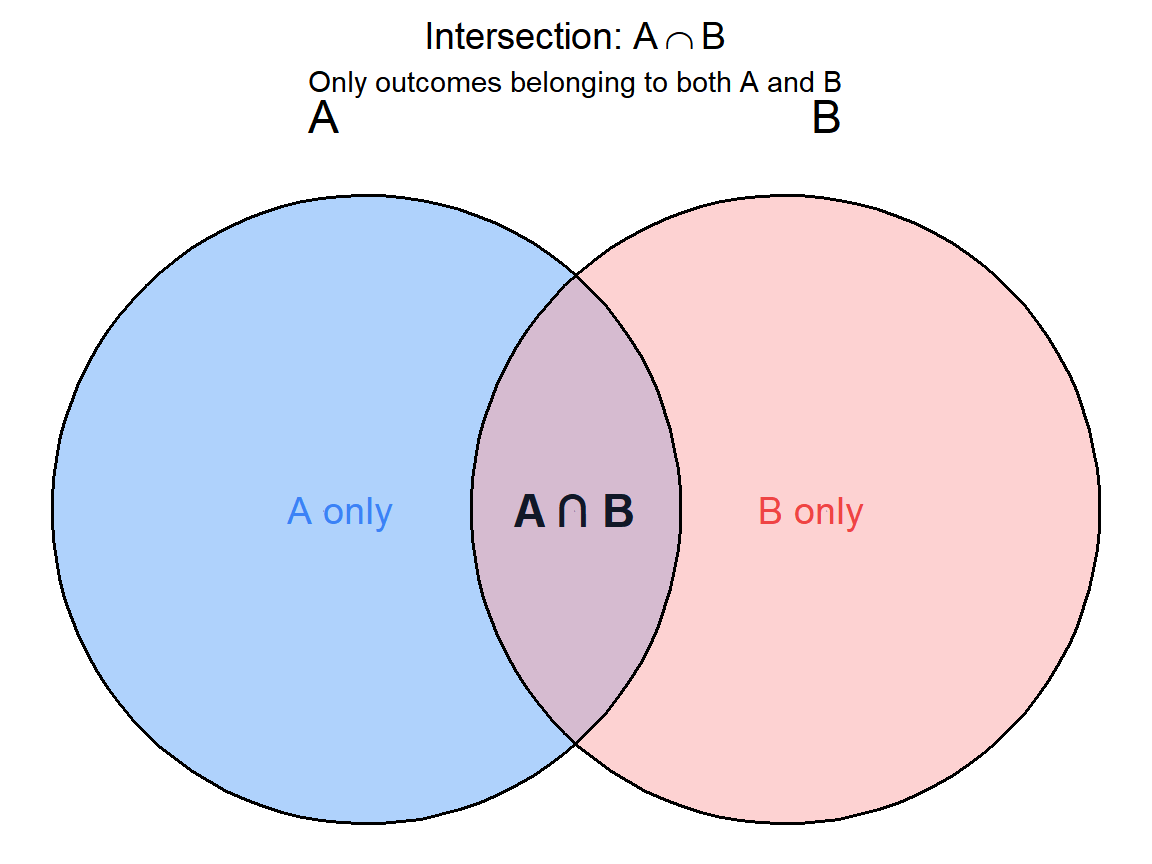
The intersection \(A \cap B\) is the event that both \(A\) and \(B\) occur simultaneously. It is the foundation of joint probability, the multiplication rule, and conditional probability.
Definition
Let \(A\) and \(B\) be two events defined on the same sample space \(\Omega\). The intersection \(A \cap B\) is the event that both \(A\) and \(B\) occur:
\[A \cap B = \{\omega \in \Omega : \omega \in A \text{ and } \omega \in B\}\]
The intersection contains only outcomes that belong to both events simultaneously. If no outcome satisfies this, \(A \cap B = \emptyset\) and the events are mutually exclusive.
Probability of the intersection
How to compute \(P(A \cap B)\) depends on whether the events are independent or dependent.
Independent events
When \(A\) and \(B\) are independent (knowing \(A\) occurred gives no information about \(B\)):
\[P(A \cap B) = P(A) \times P(B)\]
Dependent events
When \(A\) and \(B\) are dependent, use the multiplication rule:
\[P(A \cap B) = P(A) \times P(B \mid A) = P(B) \times P(A \mid B)\]
where \(P(B \mid A)\) is the conditional probability of \(B\) given that \(A\) has already occurred.
⚠️ Never assume independence without justification
Assuming independence when events are actually dependent leads to systematic errors. Two components from the same production batch are more likely to both be defective (common cause failure) than two components from different batches. Two financial assets in the same sector tend to fall together during a crisis. Before multiplying probabilities, ask: does knowing one event occurred change the probability of the other? If yes, use the conditional formula.
Chain rule for multiple events
For three or more events, the multiplication rule extends as a chain:
For independent events \(A_1, A_2, \ldots, A_n\):
\[P(A_1 \cap A_2 \cap \cdots \cap A_n) = P(A_1) \times P(A_2) \times \cdots \times P(A_n)\]
For dependent events (the general chain rule):
\[P(A_1 \cap A_2 \cap \cdots \cap A_n) = P(A_1) \times P(A_2 \mid A_1) \times P(A_3 \mid A_1 \cap A_2) \times \cdots\]
Each factor conditions on all previous events having occurred.
Step-by-step examples
Example 1: independent events - system uptime
A web application depends on three independent services: a database (\(D\)), a cache (\(C\)), and an API gateway (\(G\)). Their individual availability rates are:
\[P(D) = 0.99, \quad P(C) = 0.995, \quad P(G) = 0.998\]
Probability that all three are available simultaneously:
\[P(D \cap C \cap G) = 0.99 \times 0.995 \times 0.998 \approx 0.983\]
Despite each individual service having high availability, the combined system is available only 98.3% of the time. Adding more components always reduces joint availability.
Example 2: dependent events - quality control sampling
A batch contains 20 items, 3 of which are defective. Two items are drawn without replacement. What is the probability that both are defective?
Let \(A\) = first item is defective, \(B\) = second item is defective.
\[P(A) = \frac{3}{20}\]
Given \(A\) occurred (one defective removed), 2 defectives remain among 19 items:
\[P(B \mid A) = \frac{2}{19}\]
\[P(A \cap B) = \frac{3}{20} \times \frac{2}{19} = \frac{6}{380} \approx 0.0158\]
If we had wrongly assumed independence: \(P(A) \times P(B) = (3/20)^2 = 0.0225\), an overestimate of 42%.
A standard deck has 52 cards, 13 of which are hearts. Three cards are drawn without replacement. What is the probability all three are hearts?
\[P(\text{1st heart}) = \frac{13}{52}\]
\[P(\text{2nd heart} \mid \text{1st heart}) = \frac{12}{51}\]
\[P(\text{3rd heart} \mid \text{first two hearts}) = \frac{11}{50}\]
\[P(\text{all three hearts}) = \frac{13}{52} \times \frac{12}{51} \times \frac{11}{50} = \frac{1716}{132600} \approx 0.0129\]
About 1.3% chance. The chain rule handles the changing probabilities after each draw naturally.

Example 3: dependent events - sequential testing
A job interview has two rounds. Based on historical data: - 40% of candidates pass round 1: \(P(R_1) = 0.40\) - Of those who pass round 1, 60% pass round 2: \(P(R_2 \mid R_1) = 0.60\)
Probability of passing both rounds:
\[P(R_1 \cap R_2) = 0.40 \times 0.60 = 0.24\]
Only 24% of all candidates make it through both rounds.
💡 Intersection vs union: which formula to use
- “Both \(A\) and \(B\)” → intersection: \(P(A \cap B)\).
- “At least one of \(A\) or \(B\)” → union: \(P(A \cup B)\).
- If you know the events are independent, multiply: \(P(A) \times P(B)\).
- If the events are dependent, use the conditional formula: \(P(A) \times P(B \mid A)\).
- To check independence formally: verify that \(P(A \cap B) = P(A) \times P(B)\). If they are not equal, the events are dependent.